Showing posts with label pgs. Show all posts

Tuesday, September 27, 2011

PGS APOLLO

PGS ApolloThe PGS Apollo (IMO: 9378228, Port of Registry: Nassau, Bahama's) is a 3D seismic vessel. She is equipped with 10 full length streamers and 12 streamer reels. With a transit speed of 18 knots, she is designed to move rapidly between jobs, cutting non-productive steaming time by several days. The vessel is 107 meters long and 20 meters wide. Main propulsion machinery consists of an arrangement of two MAN B&W 9lL 32/40 desel engines producing 4,500 kW at 750 rpm and two MAN B&W 6L 32/40 diesel engines producing 3,000 kW at 750 rpm. She was delivered in April 2010 by shipbuilder Factorias Vulcano SA to her owners PGS (Petroleum Geo-Services).

The PGS Apollo is expected to arrive later tonight at the Waalhaven, Rotterdam.

Click here for the current position of the PGS Apollo

Monday, July 05, 2010

RAMFORM VALIANT

Ramform ValiantThe Ramform Valiant (IMO: 9165023, Port of Registry: Nassau, Bahama's) is a seismic survey vessel, delivered in 1998 by Langsten S&B, Norway for her current owners Petroleum Geo-Services, Norway. PGS operates six Ramform vessels, each capable of towing 12+ streamers - the only such vessels operating in the world today. All known streamer handling and towing records are held by Ramform vessels. The Ramform Valiant is 86 meters long, almost 40 meters wide. She was the first of the 20-streamer V-class ships and has worked in Europe and West Africa, as well as North and South America.

The Ramform Valiant is expected to arrive later tonight at the Waalhaven, Rotterdam.

Click here for the current position of the Ramform Valiant

Tuesday, April 24, 2007

RAMFORM EXPLORER

The Ramform Explorer (IMO: 9118472) is a sistership of the Atlantic Explorer, which was SotD on September 7, 2006. The Ramform Explorer is a seismographic research ship owned by PGS Geophysical AS and is capable of detecting all kinds of underground fields, such as oil fields by using 3D techniques (More information at the PGS website or the above link of the Atlantic Explorer). Streamer seismic has been the keystone of PGS' services from the beginning. With six Ramform vessels complemented by four “standard” seismic vessels, PGS has understandably established a leading global track record for 3D operational efficiency and innovation.
The impact of the PGS Ramform technology on marine seismic exploration is uncontested. The Ramform design produces performance levels and efficiencies that continue to set new industry standards for high-technology seismic acquisition. Today approximately 80% of the world’s advanced technology seismic surveys have been acquired using PGS Ramforms — the most advanced seismic fleet afloat.

This boat launched the Ramform class and was the first ever seismic vessel to tow eight streamers, the first to acquire over 1,000 square kilometers in a month, the first to tow 12 streamers and the first to acquire 100 square kilometers in a single day.

The Ramform Explorer is expected to enter the port of Rotterdam this afternoon and will berth at the Waalhaven.

Tuesday, October 03, 2006

OCEAN EXPLORER

photo by Terje MoenThe Ocean Explorer (IMO: 7805239, Port of registry: Nassau, Bahamas) is a seismographic research ship owned by PGS Geophysical AS that is capable of detecting all kinds of underground fields, such as oil fields by using 3D techniques (For more info, also look at the Ramform Explorer and the Atlantic Explorer). The vessel was built in 1979 by Ulstein Verft AS, Norway and was formerly known as Tender Comet, Far Comet and Amy Chouest. The vessel is the oldest vessel of the PGS fleet and also one of the smaller ones with its length of 80 meters and a width of 18 meters.

The Ocean Explorer has entered Rotterdam this morning and is currently berthed at the Waalhaven.

Thursday, September 28, 2006

RAMFORM EXPLORER

The Ramform Explorer (IMO: 9118472) is a sistership of the Atlantic Explorer, which was SotD on September 7. The Ramform Explorer is a seismographic research ship owned by PGS Geophysical AS and is capable of detecting all kinds of underground fields, such as oil fields by using 3D techniques (More information at the PGS website or the above link of the Atlantic Explorer). Streamer seismic has been the keystone of PGS' services from the beginning. With six Ramform vessels complemented by four “standard” seismic vessels, PGS has understandably established a leading global track record for 3D operational efficiency and innovation.
The impact of the PGS Ramform technology on marine seismic exploration is uncontested. The Ramform design produces performance levels and efficiencies that continue to set new industry standards for high-technology seismic acquisition. Today approximately 80% of the world’s advanced technology seismic surveys have been acquired using PGS Ramforms — the most advanced seismic fleet afloat.

This boat launched the Ramform class and was the first ever seismic vessel to tow eight streamers, the first to acquire over 1,000 square kilometers in a month, the first to tow 12 streamers and the first to acquire 100 square kilometers in a single day.

The Ramform Explorer is expected to enter the port of Rotterdam this afternoon and will berth at the Waalhaven.

Thursday, September 07, 2006

ATLANTIC EXPLORER

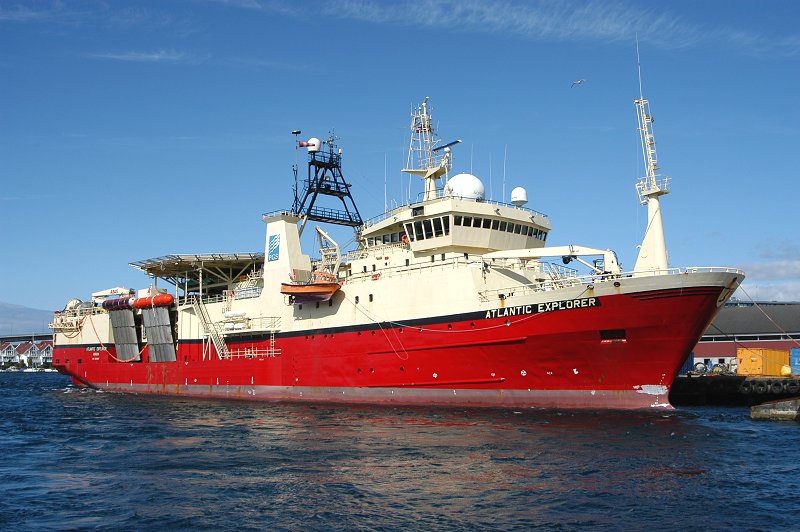
The Atlantic Explorer (IMO: 8610667, Port of registry: Nassau, Bahamas) berthed last night at the Waalhaven, Rotterdam. The vessel is a Seismographic research ship owned by PGS Geophysical AS and is capable of detecting all kinds of underground fields, such as oil fields by using 3D techniques (see picture below). Seismic data and 3D seismic data in particular are fundamental in the exploration, development and production of hydrocarbons. These data are used to assess prospectivity and identify potential hydrocarbon resources, to perform detailed mapping of the reservoirs in the field development phase, and to monitor how the reservoirs are being drained during the production phase.

As the industry’s second six streamer ship, the Atlantic Explorer became the first vessel to offer full onboard seismic data processing in 1994. Working in Angola during 1996, the Atlantic Explorer became the first six streamer vessel to acquire over 1000 square kilometers of data in a month.

The ship is 91 meters long, 17 meters wide and was built in 1987 by Hellesøy Verft AS, Norway.

Popular Posts